Sunday, 29 August 2021

Evidence of Possum Wrecking Deployment Site

While we are currently in a national lockdown we have limited sound lure testing in progress.  We are collating the data and information as we continue to modify and test the viability of various units.   This morning when checking a deployed camera there was a series of images that require explanation as they are quite striking.

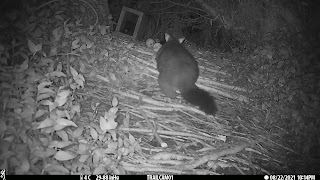
In the first image in the series we can see a brush tailed possum approaching deployment site one.   There is an object that is visible just outside the rat box, when looking closely at the trap box you can see that the trap itself has not been sprung which would suggest that it is not a rodent, which is what originally was suspected, outside of the trap but another object which has ended up by the trap.
In the second sequence photo the possum can clearly be seen with this object in its mouth while it is in the area of the trap.    Again while we originally thought that the object could potentially have been a trapped rat and that the possum was feeding on this, a close examination of the photo shows that the t-rex rat trap has not been sprung which shows as evidence that it must be another object that the possum is carrying.

The third photo in the series which has occurred five minutes after the first shows the deployment site after
the possum has finished with it.   

This is typical of the interaction that we have seen of the brush tailed possum with the sound lure and in the sound lure area.   We see the objects like the rat box moved around which typically have been jumped on by the possum or knocked over in an attempt to investigate them further.   The lures themselves when not protected can be moved and wrecked, knocked over and pulled out (although we have had minimal unit damage and it is usually a case of physically resetting the trap area and the trap set up and putting everything back in place).

We will refine the trail cameras settings to increase the frequency of the photographs.

Note: We are currently in a national lockdown under level four restrictions - this monitoring is occurring at a private location which is next to a residence so no lockdown rules have been violated in carrying out this testing.



Sunday, 22 August 2021

Reviewing the Initial Unit after Twenty Months Deployment


Pictured Left is one of the initial units which was deployed outside in November 2019.   This unit while it has undergone several basic revision is essentially the same and is still functioning, despite having being deployed outside constantly for an entire winter.

The solar panel was a $12.00 (5v/1.2w) purchase via Ali Express in October 2019.   It has produced enough power to run the unit in regular circumstances although it can struggle without responsible exposure after two days - we replaced this unit and upgraded it to a $25.00 solar panel in 2020.   There is some variation in the power from the larger solar panels, as a general rule we would expect around 

The connections which were single wires have subsequently been replaced with speaker wire available from a local hobby stockist.  We have seen animals chew these wires and claw at them but not particularly damage them.    Neither elements of the unit have needed to be replaced for its existence.    The speaker was replaced, we have currently upgraded as speakers working with the units as we have refined the design.    These have suffered in the elements - the original 4w speakers that were part of the project were purchased online from Aliexpress for $2.00 each and were replaced by more durable speakers (that cost double the price).   We have customised the baffle by 3D Printing,

The IP rated box which was purchased for a minimal amount ($20.00) has been excellent and there is minimal evidence of moisture entering the unit.   With other units in the sequence we used desiccant to absorb moisture and we are now looking significantly at using MDF to absorb moisture and provide a platform on which to mount the breadboard and hold the battery in place.

We are using with this unit the same basic program that has been present for two years, although we have already stated we could clearly use a significant increase in the number of sounds and the frequency etc.

The area where the unit is being deployed has undergone considerable rainfall including the river within a few metres of the camera/trap set up bursting its banks for the first time in seven years.

It appears that activity in the area is returning to normal.   We are using the area to deploy two units at present to test that the lures are operating and working.

As always we will continue to monitor what is occurring at the site and identify interactions of note and interest.   We are continuing to run trials for stoats at both DOC sites and locally and once the COVID-19 levels of restrictions we will complete our sound level investigation into possums.


Wednesday, 11 August 2021

Final Phase of Curious Minds Data Gathering


We are undertaking the final aspect of our Curious Minds data gathering process.  As part of this process we are running sound lures on multiple sites in South Taranaki on local farms.  At each of the farm locations we have sound lures working in conjunction with a Timms trap as well as a non-sound lure location with identical baiting.   We are intending to deploy for several months and will be monitoring eight sites in total.  At least some of these locations will be covered by trail cameras and some sites will rely on the count of possums that are recorded.   This trial will be featured on a trap.nz project and this will be made available for data gathering purposes.  We also have a number of images that have been gathered from recent deployments.

We have again shown clear evidence of the interactions that are occurring between possums and possums that are deceased and have been trapped.   There is considerable post trapping activity that is taking place with behaviour and mating.   This is important because it is underlining the important potential link between the sound lure and using other possum noises to attract additional possums.   We are thinking that the sound of a distressed possum would prove to be enticing based around the anecdotal evidence that we have been gathering.   Currently we have been concentrating on the units creation and proof of concept testing - we are considering that the sound has been able to draw possums in - and this would appear to be even more of a consideration when looking at stoats and other animals.

We are looking to complete the project in the next few months, when we have gathered the final data from the project the school aspect of the project and our Curious Minds Project will be completed.

We will continue to investigate the use of the sound lures to attract target pests and continue to investigate possibilities in the future although the project has final report deadlines to be produced.  If you would like to contact us prior to the conclusion of the project please do so via email as soon as possible.


Sunday, 18 July 2021

Intensified Non Sound Lure Behaviour

Recently we have been running extended trials with the sound lure targeting brush tailed possums with a new sound lure profile, and a decision was made to run at the same location without the sound lure for an extended period of time to chart the difference.    

There were several factors that occurred of note during this time.   Firstly there has been another successful capture at this location using the Timms trap, the second in three days, the first with and the second without the sound lure.    

The second is the heightened activity that we have seen where a trapped possum has remained in a trap for an extended period of time.  Typical of that occurring the activations on the camera and the interaction with the dead possum from other possums.  We are consistently seeing hundreds of activations at locations where typically we would expect twenty or thirty in an evening.   During this time we are seeing possums interacting with the dead possum, ripping fur off the dead animal and mating with it.      


This pattern repeated itself during this monitoring phase as over the five day of monitoring there was nearly a thousand activations.   Almost all of these occurred following the capture of the first possum where additional possums then came into the site and activated the camera by interacting with the possum.

In normal circumstances the trapped/dead possum would be removed in the following morning - however in this instance due to being absent from the location for five days it had to remain in the trap.    Three days of extreme heightened activity occurred with a variety of possums, including a mother and baby and a possum that had a distinct tinge of red or brown in the colour of its fut.

Also of note - the sound lure was not present and during the entire time there were no rat activations at the site - there has been numerous in the previous deployments including repeated large rat activations - these ceased for the duration of the five day only non sound lure deployment - there were no rat activity at all.

Finally New Zealand and our region has had a massive rainfall during the last three days of the deployment on the final day the water from the river, which is usually eight metres or so from the river to where the trap is located, had an unprecedented water level rise, as can be seen from the photograph on the left.   The affect that this has had on the activations will be investigated.


Monday, 12 July 2021

Third Night of Increased Activity: Possum/Rat Activations

In the third night of revised volume levels we have again seen an elevated level of activity at deployment site one.   This has been amongst some of the highest 'Winter' activations at the location in the past two years.   There has been numerous brush tailed possum visits to the site (three seperate occasions) large rodent activity (a rat that would be unable to access the rat box based on its size as it would not be able to fit into the trap area and various mice, including one that activated the trap).  The first activation shown left is of a brush tailed possum which has accessed the site, but not interacted any further with the location, it can be seen above the lens of the trail camera and is on the tree opposite the traps, as its fur can be seen above the camera.

The first set of activations at the site start at 10:00pm and last for over ten minutes and include twenty six activations (photographs) of the brush tailed possum.  Typical of the last view days the interest shown by the possum seems based around the sound lure unit, the small rat box, and it is not paying attention to the Timms trap which is immediately to the right as shown in the photograph.

The third set of possum activations during the night takes place starting at 1:01am and finishing at 1:08am.   Again in this brush tailed possum activity shows a repeat of what we have seen over the last few nights, the interaction is taking place with the unit, which is a baited rat trap, while the Timms trap, which is baited with pineapple is not interacted with.     The brush tailed possum climbs over the unit, looks inside and around it, while not investigating the other trap.

The final set of activations occur from 1:36am to 5:15am and rodent based activity - including a number of large rat photographs.   This location is adjacent to a river, and the rat box in use has a chicken wire entrance as opposed to a wooden tunnel, and based on the photographs one would assume that the rat would have some trouble entering the box, although not impossible (there is also a mouse that was trapped at some point during the night at the entrance to the trap although it is not obvious when this occurred).   The rats generally spend the time around the sound lure, although there is an interesting photo of it stretching on the Timms trap to give an idea of the size of the rat.    There are again numerous mouse photos as well.

In summary three nights of activity at this location have the following to note: 

  • there is an absence of any domestic or feral cat activity, which has dominated this site in the past.   The cats have previously shown considerable interest in the lure, although this has lessened overtime (time frame here is two years) including when the lure was first used around the house the cats would interact directly with it, including spending time trying to get into the box etc.
  • at the present time there have been repeated brush tailed possum interactions with the lure at this site, almost exclusively just the lure while the possum(s) ignores the traditional trap.   The possums appear not be scared away by the unit activation (based on the time that they spend at the site and the time that the lure is operating) and remains on site while the unit is activating
  • rodent activity is also occurring at the site which is not deterred by the unit operating again based on the number of activations that are occurring and the operating cycle that the unit is running.

Sunday, 11 July 2021

Brush Tailed Possum: Sound Lure compared to traditional trap

We have recently started using a new set up with a slightly more subtle set of sounds, with essentially a smaller speaker (although we can further reduce or set the sound volume level of the speaker and also have it operate at levels depending on the time of day or light level).

Yesterday was the first deployment of new unit and had a considerable number of activations in a single evening.   The second night of activations has seen an increased number of activations - and three seperate interactions with a possum/possums during the course of the night.   The first possum arrives at the site at 9:46pm - this possum ignores the Tims trap and proceeds to tip over the rat box where the sound lures is located.   The possum in this instance is photograph thirty seven times and spends a total of twenty five minutes at the location when the unit is repeatedly activating.   The possum interacts almost exclusively with the sound lure and ignores the traditional trap.

The second set of activations occur two and a half hours later.   The possum in this instance arrives just after midnight at 12:02am and remains on site for five photographs.   Again as with the first instance the interactions are exclusively with the rat box, now tipped over, with the sound lure operating from within it.    This possum is present at the site for a shorter duration than the first one and departs again by 12:03am.

The third set of interactions with brush tailed possums occur at 12:55am and lasts until 12:57am.  A possum enters the trap  area and interacts exclusively with the sound lure, ignoring the traditional trap that is to the right.

Again we wish to stress that this is the first in a range of new testing and the location of the lure immediately next to sound lure is possibly not the most robust science, but there is a clear preference for the brush tailed possum in the instances from the last two days to target and interact with the sound lure trap within the rat box and to ignore the traditional Timms possum trap which is deployed adjacent to it.

Saturday, 10 July 2021

Subtle Change in Speaker/Volume Levels: Further Possum Activity

We have modified several of the deployed units with the expressed purpose of checking and refining the volume levels of the speakers.   While we are currently conducting considerable trials in the effectiveness of the stoat based version of our units (thank you again Feral Control, Taranaki) we are also moving ahead with our brush tailed possum trials.

We have adjusted our speakers recently looking for something that is more subtle, particularly as we are seeing indications that possums are investigating everything and we believe that other animals that we want to target have a range of hearing more specific to a lower sound range.

Our first indications with our new version of the possum lure is again showing promise - on the very first night of trials we have had a sound lure unit, set up inside a rat box with a standard sound profile and had a Timms possum trap with fruit bait.   We have had a significant possum interaction with the unit - a brush tailed possum has appeared, spent time interacting with the unit - while it has spent time at the general site by far the most significant interactions have been between it and the sound unit, including repeated attempts by the animal to gain entrance to the box from the front and the back as shown in the photographs above.    It has taken fruit left at the site, eaten it, and been active at the site for forty minutes, including climbing over the rat box and investigating it extensively.   

We will be monitoring site one again, after a period of a break to determine what will happen with the new profile and how relative it will be for the trials.  We are also going to shortly create a specific possum sound lure trap.nz profile/project where we will be placing our results as we more forward with the final phase of our testing.

Please note due to a manual error in the camera setting the incorrect date and time have been displayed in the photographs that were taken overnight.   The correct date for the activations was the night of Saturday 10th of July/Sunday 11th of July.