Showing posts with label Brush Tailed Possum Activation. Show all posts

Monday, 24 January 2022

HD Video Footage: Cautious Possum

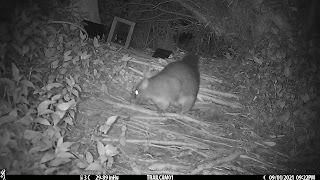
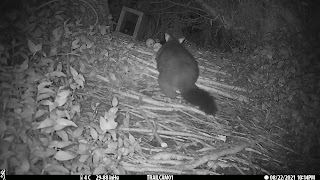
 We have mentioned on this blog repeatedly a possum with dark fur, that appears to be a male that has appeared at the site numerous times and has been described as ultra cautious.  This video from the 23rd and 24th of January gives an example of what we mean when describing this particular animals behaviour.  

The possum first appears from behind the tree at 11:20pm and spends time observing, but not approaching the trap (which is activating during this time).   The possum is adopting the two legged stance during this time.

We have placed next to the trap a pear, which is lying there just in front of it - the possum observes but does not approach either the trap or the pear.  It returns at 12:13am and slowly approaches the site from the same direction, listening as the lure operates and observing.

A full five minutes later, after standing almost motionless watching and observing it makes a move forward to the pear, nudges it with its snout, attempting to bite it and almost instantly pulls its head back and runs back from the area (the lure did not operate during this time).      The possum then exits the site via the tree.

An unknown possum then arrives at the site at 12:47am this possum is active in the tree containing the camera and is observing the site from the adjacent tree.  This possum is most likely responsible for the removal of the pear which occurs shortly after this.    There is no footage of the pear leaving, but the next activation at 12:51am (also from the adjacent tree) shows clearly that the pear has disappeared by this point.   While we cannot be certain that the male is responsible for this he has been seen putting his head inside the Timms trap and removing it almost instantly - there has been activations of the trap where an animal has removed itself despite activating the trap and it is not inconceivable that this possum is responsible for this.

In regards to the sound lure in general this possum is still showing interest in the area, is repeatedly observing and returning to the site and is not showing obvious aversion to the noise generated by the lure, however after several months of playing the same sound profile (at random times generated by the computer program) there is still interest shown by this possum.

Wednesday, 5 January 2022

HD Video Footage Summary: Using LED Lights


This is the first instance (evening activity summary) of using four blinking LED lights at deployment site one.   There is a variety of activity on the site - weather conditions were clear.


Second night of activity at deployment site one - a summary of the activity between brush tailed possums and rats with four blinking LED lights operating - see summary details below of the setup.


Saturday, 1 January 2022

2022: New Years Trapping Progress

 We have restarted monitoring at Deployment Site One.  The focus has been to return to the traditional five sounds we initially used to target possums.   These are playing on a one minute interval (subject to battery level if the battery is charged more frequently the unit is programmed to play more often) with one of five random sounds.  The site is being monitored by HD Cameras that are recording interactions at the site during the night.   There is a Timms trap deployed at the site, baited with apple - the sound lure has been attached directly to the back of this unit as there has been a hole drilled via the back where the speaker is then linked to the unit.  A second alternate unit has been placed next to the compost heap on the property bordering this location, to put it in context on the property itself twenty seven possums have been caught in the last three years, using a variety of bait (almost exclusively apple or pear)

In the previous nine days the stoat box, which has been deployed during the past six months recorded a strike of a rat.  This is the first capture from this unit and it occurred sometime from December 23rd to December 31st.  There was no sound lure operating during this time.

On the night of the 31st of December/1st of January there were a total of four visits from brush tailed possums visible on camera.   None of the animals activated the trap - it appears that the black male that was present in November/December is still in the area and this animal in particular seems very trap wary.  The alternate trap, placed next to the compost heap (without sound lure) was activated and a female was caught.

The follow night, with the same set up, including the same bait - there was some of the highest activity present during all recording.   There were seventeen seperate series of video activations starting at 9:43pm and concluding at 4:12am on the morning of the second of January.


Above: This specific video deals with the sound lure/rat interaction from January 1st/2nd

The domestic cat was first on the scene, briefly at 9:43pm followed by a series of brush tailed possum activations.   Possums arrived at 10:09pm, two were present at 10:22pm.  At 10:32pm a male appeared which fled up a tree, returning at 10:42pm.   In-between this a extremely large rat appeared at 10:38pm.  The possum left at 10:48pm when another rat reappeared.   Possums then came to the site at 12:19am on January 2nd and returned at 1:48am.

During this time there is clear evidence of the sound lure repeatedly operating with the various possums reacting to it (the rat showed no reaction) or continuing with their activity.   There was one example of clear aversion from a black male at 10:32pm - although this animal clearly returned at 10:42pm.    (This again is quite possibly the same male observed since November which is very careful around the trap).

At 1:48am another brush tailed possum arrived - and this animal activated the trap and was captured.   This animal was able to pull the Timms trap down the hill and moved the setup, including the sound lure, which is why after the capture the lure is present and the trap itself is not, as it was just out of sight.


Above: Specific Highlights from Jan 1st/2nd a sample of the 17 distinct interactions recorded

There were further visits to the site following this capture at 2:47am, 3:02am, 3:21am, 3:44am and a final visit at 4:12am.     In each of these visits animals arrived at the site and interacted or showed interest in the scene or the lure.   There was no evidence of post capture activity towards the captured female.    

In summary: 

  • there was heightened activity on the second night including a record number of visits: a record for this site.
  • two day old apple proved successful at the river site (there was not a follow up strike on the compost site, which there is currently not a camera monitoring)
  • the domestic cat visit was the first in a year or so, although the cat may well have been passing through the site and did not linger as it has done in the past
  • the capture at the river was the first since November 17th and camera footage would show that there is a significant number of possum activity in this riparian planting area
  • the rat is the first HD video footage that we have recorded, although there has been activity here in the past.   It was interesting to see that the rat did not react to the possum noise and also was clearly in the vicinity at the same time as the possums.

Saturday, 11 December 2021

Sound Lure Project in the Media - Wrapping Up 2021

 We have been featured recently indirectly in a two seperate articles and locations.   The first was indirectly when during an article on the students program What Now! one of the students who was featured was shown a range of equipment that was used in possum control and one of those items was one of the projects sound lures was demonstrated to the student.   The link here is to the Facebook link of the news article.


The second appearance was as part of the 123 Tech National Finals - the students from Auroa Primary School were the winners of this competition last year (see this link for the competition) and we were also spoken to for this years competition - the link to that is here.

While we did not enter the competition with our students this year we wanted to take the opportunity to congratulate all of this years winners on their achievements.

Finally we are continuing to work on our sound lure project and focussed on the distress lure. brush tailed possum combination.   This has taken somewhat of a back seat due to other commitments at present we are however continuing to monitor and test and look forward to making some announcements shortly as we look to close the project up.

This brush tailed possum was photographed last night interacting with the lure.

Sunday, 14 November 2021

Updated Timms Trap and Recent Phase of Testing Summary

The current phase of testing can be summarised as follows:

Sunday 24th October - Saturday 30th October - Sound lure operating in conjunction with a range of sounds from the traditional profile (stoat, rats, distressed rabbit).   Significant activity in the area including repeated interaction with the trap station with lure operating.  Up to five visits a night with significant time spent at the location almost exclusively with brush tailed possums.

Sunday 31st October- Thursday 4th November - Sound lure operating making a range (five) of brush tailed possum sounds playing at a one minute interval.   Significant activity in the area including repeated interaction/return visits to the site and trap station area with lure operating.   Some evidence of animals leaving the area at speed but based on the time stamps and basic animal identification these animals returned shortly afterwards.  Animals present included a mother and baby and several adult males all of whom remained on site for extended periods of time.

Friday 5th November - Wednesday 10th November - pest removal phase during a five night period four brush tail possums were removed at the location.   There was a fifth activation where there was clear evidence of a possum having sprung the trap but managed to avoid being caught.   Due to technical errors with the trail camera last recordings took place on Thursday 4th November (moisture) however still photos taken the following morning.    The morning of the 10th the lure was operating but there was no evidence of interaction and the bait was not removed.

Thursday 11th November - Saturday 13th November - We left the Timms trap at the site but removed the sound lure due to the weather conditions and to see what would be happening.   The trap was baited with apple (as it had been since Friday 5th).   During this period there were no activations at the trap location or evidence of the bait being taken, and the site remained static.

Sunday 14th November - Overnight we replaced the sound lure for the first time in three nights (which had the same apple bait since the 10th).   When we observed the site the following morning the trap had been sprung, the apple had been pulled from the trap and had been significantly eaten.   As there was no camera monitoring the site (as there hasn't been since the 4th) there was no direct evidence of what had occurred but it seemed clear that a possum had been in the area.   

The stoat box, with salted rabbit meat has been static the entire time.   We now have in our possession cameras in which we will be able to use to monitor the site and record footage of what is occurring and we indeed intend to at the first available opportunity (ie weather permitting).

I feel compelled at this time to again issue a disclaimer about this testing.   This phase of testing is being conducted at a single site a short distance from a location where I live.  It is not intended to be scientific with comprehension proof of what is happening it is merely a record of what is occurring at the moment and I am well aware the variables that are being used are very basic (and there is no alternative).  It is very much conducted by a non scientific teacher in spare time.   If you would like to conduct testing using the equipment an the sound lure we have units available for use, please get in contact with myself via the blog.


Saturday, 6 November 2021

Second/Third Consecutive Night: Timms Success


For the third consecutive night we have had success at the location where we have been again focussing on the sound lure combined with a Timms trap.

Update: Monday 8th November (Day Three).  There was a further activation overnight, which was clearly a possum strike on the Timms trap, in this instance the trap was activated, the bucket had moved with the pins pulled up and the bait removed - this has been seen before when a possum activates the trap and then subsequently escapes.

Night Two Summary

In the photo you can see the sound lure immediately behind the Timms trap, were it is linked to trap.  Next to the Timms is the stoat box which is still baited with salted rabbit to target stoats.

A smaller female has been caught, interestingly the bait in the Timms trap was not present suggesting that another animal or this animal had removed it, but then continued to interact in the trap resulting in its removal.

Incredibly frustratingly we cannot answer the question with absolute certainty as the event was being monitored by a trail camera that despite prior testing did not operate (record) as had been anticipated.   This is our final operational HD Video camera and until we repair our current stock or replace it (which is challenging as we have spent our funding and currently winding the project up).   Our project funding closed and we are currently trying to maintain the project on cameras that were initially purchased two years ago.

However if we reflect on our goal from the past two weeks and answering the question of a deterrent we can state the following.

Brush tailed possums were clearly active in the area when the sound lure was operating from inside the DOC 200.  There was interest shown in the unit when it operated but the possums did not show signs of stress or a change in behaviour when the unit operated (such as stopping feeding or showing signs of aggression),   This behaviour was repeated over several nights, including what appeared to be the same animals return to the site repeatedly.   We can surmise the unit did not repel animals during this time.  There was limited food placed around the trap to see if the animals would feel safe enough to feed when the unit was operating.

Brush tailed possums were clearly active in the area where the sound lure was operating from inside the rat box.  We saw evidence of repeated visits to the site from a range of animals including animals clearly remaining on the site for an extended period of time.   There was evidence of some aggressive stance from the male possums who were seen, and some evidence of behaviour leaving the site from a female and a baby.  It is possible that this was the arrival of another animal (as the timing on the camera would suggest) or the unit operating.   If animals did leave the site they appeared to reappear later in the night, and then spend extended time at the location.     We saw evidence of interest shown in the lure and also the general trap area including the possums opening the box the sound lure was hidden in.

Changing the unit set up to switch to a removal phase involved taking the unit and placing the speaker at the rear of a Timms possum trap allowed us to trap a series of possums.   

Over two (now three) consecutive nights two possums were caught, a male on Friday night and a female on Saturday.   The male showed evidence of being clawed after being caught (which would be by another male as seen before) as fur was present around the trap.   The female was caught although the bait was missing from the Timms.   The third night saw the trap clearly activated, pulled from the ground and the bait removed, however the animal (which is almost certainly a possum) was able to escape from the trap.

This is showing us that the use of the Timms to increase the sound (as it echoes inside the bucket) making the noise louder is not deterring the animals from the site.   This is two consecutive captures a a third nearly clearly occurred over three consecutive nights.

It is very frustrating from our point of view that technical issues with the trail camera has prevented us from recording the interactions on the final phase of the trapping - while we would not have posted the footage here on this public blog for obvious reasons we would have had some more conclusive evidence to ask our short term focus question.   This would reinforce what the evidence from the last two years has strongly suggested to us about the viability of the unit and the potential affect that it has had.

I finally feel again compelled to remind everyone that this entire research and operation is being run on a part time basis by (primarily) two people operating in their 'spare' time.    This is not being conducted as a full time scientific investigation and I would suggest that these results are open to interpretation.

Friday, 5 November 2021

Timms Trap and Sound Lure Success


As noted previously we have started to experiment specifically with HD video and the sound lure to determine what specifically brush tailed possums might be reacting to with the sounds from the sound lure.

It has been suggested that the sound lure, while designed to attract pest animals to the site of traditional traps could be instead acting as a deterrent to cause animals to avoid the location.  For the previous week and a half we have been deploying a HD Camera to help us answer this question and using a basic analysis of the video to note the response of the animals when the unit activates.   During this time we have seen clear evidence of multiple visits to the site during the evening by a number of brush tailed possum.   There has been a mother and a baby and at least two distinct males returning to the site.   The unit has played repeatedly during this time and there have been up to eight activations in a night.   

Previously we have not focussed on attempting to trap any possums at this location - we have simply been trying to determine if we can answer the question and test or note their reaction to the sound being activated (as noted it is on a one minute delay).   The sound lure was previously located inside of the DOC200 (see picture) however we for the first time switched it to placing it inside a Timms possum trap.   We used an electric drill to make an opening in the back of the Timms, which the speaker was directly attached to unit - this had the effect of acting to amplify the sound considerably.

Rather frustratingly the trap work perfectly.   The frustrating part of this was that the camera that was monitoring the unit did not.  We made a capture at the location of a significant male (buck) possum.

There was additional evidence of a further possum attack - which we have repeatedly seen, where a dead possum has been attacked by a second possum as there was ripped fur around the capture, again this frustratingly was not recorded as the camera was not able to record it.   

Once again I feel compelled to point out that this is a single location where we are merely testing our equipment to get it to the point that we can be confident that it is operating as we intended.   We would like to make the technology and the experience that we have had available for wider use and the data and information likewise.

Back to the original question that we are currently focussed on answering.   We have had multiple activations at our site over an increasing period of time.  We have had some limited evidence of possums leaving the site when the unit activates, however in every case we can then see them return and we are having multiple visits during the course of an evening.  

Obviously we have to look at our capture rate with the Timms trap, but one would suggest the fact that a capture was made, and at least one additional possum was present (as evidenced by the fur from the first possum) and again this would suggest that the lure is not acting as a deterrent.

Moving forward we will continue to monitor the site and look at adjust the camera footage recording so that it operates successfully.  We are not going to simply upload hours of footage that we already have showing the lure/possum interactions as we have already done with some parts, however that is available on request.

Tuesday, 2 November 2021

HD Footage: Possum Interaction with Sound Lure

As a continuation of the recent experiment to record HD camera footage of the sound lure making brush tailed possum noises, with a concealment of the device inside a box, obscuring its view.    Last night activations have topped the previous night and we have seen similar levels of activity.

The first appearance from a mother and a juvenile took place between 9:21pm and 10:10 pm.   A male then appeared shortly afterwards before a smaller possum, quite possibly from earlier, spent time at the monitored site from 10:23pm until 10:30pm.   

This was followed by another male brush tailed possum who was present from 10:30pm until 10:37pm.   

 The juvenile then appeared for a minute, before the male appeared again followed by the female and the juvenile who were interacting.    The dark male appeared again at 10:55pm and left at 11:00pm before the female and juvenile appeared at 12:40am until 12:45am, making a final appearance at 1:57am  and were present at the recording site until 2:10am.    While there was only a small time between various possums viewing the footage makes it clear these were different animals and the only two who interacted were the adult female and the juvenile.

All in all there were ten distinct phases of activation from a minimum of what appeared to be at least four possums, a female and a juvenile and the two adult males, one which is clearly darker than the other.   This is consistent with the previous nights activities, although the number of activations has increased and there were seventy total activations/video footage.


The possum that jumps directly into the camera in this activation, returns to the site four minutes later and remains at the site and hears the sound lure activating several times, but continues to feed.

A summary of the activities from the evening has also seen the sound lure/bait station wrecked by possums dragging the boxes away, and showing interest with and interaction with the sound lure.   There is some evidence of adverse reaction, although this is limited (such as the possum jumping into the camera after an activation - however once this occurred the possum then returns to the site after a few seconds).   Clearly there were repeated activations when all (four) possums were at the site and they returned to the site repeatedly during the night.

Sunday, 31 October 2021

HD Sound Lure Interaction - Possum Sounds

Over the weekend we have begun the important phase of testing the sound lure, but operating with an HD camera to record the interaction between the Brush Tailed possum and the sound lure.  It was previously suggested that the sound lure could potentially be acting as a deterrent to pest animals and instead of attracting them as intended could be causing them to avoid the area.

In the last week we used a unit which had a generic sound profile - this evidence suggested that the animals were non-plussed by the unit activating when they were in the area, particularly if they were feeding, as shown in various videos posted on this blog.

We are using for testing purposes a unit that has been deployed constantly now for two years (that is two years out exposed to the environment).   The unit has the standard five track set up, in that it is playing one of five random tracks at a one minute interval.   The unit is solar powered and is controlled via the same computer chip and MP3 player from two years ago.   The sounds that are being used have come from youtube, that is they were sourced from random brush tailed possum sounds that are freely available (and were prepared by students during the project last year).   


For the purpose of testing we placed the sound lure next to the existing stoat box.   We placed the sound lure inside a rat box which we then adjusted by blocking out the back, so that it was not visible for a possum to check directly inside the box.    There were some additional food that was placed next to the trap, carrots, as the key issue that was to be identified here was not to catch possums but to see what interaction would occur between possums and the lure.

Finally I would like to personally acknowledge the work on the project from Andrew Hornblow in Opunake who is responsible for the electronics for the project.  It has been and continues to be immense.   I would also like to make it clear that this project officially ending very soon - I am not personally, nor have I ever been a full time researcher on this project and it has been conducted in my spare time.  It would not have happened with the support of the Curious Minds Project from Venture Taranaki.   When that project concludes shortly the funding for the project will not continue (for instance we have a single tracking camera remaining from our outlay of five and are having to bring it in if there is a hint of rain in the area is case that it damaged by moisture).

A final reminder - this is a single nights activity we going to continue to monitor the effectiveness of the units and the sound interactions moving forward in a limited capacity.

The key question was - was the sound lure causing animals to avoid the area where it was operating.   

The answer, and I believe that we have the starting to compile evidence to back that up, is no.   

For the during of the evening at the location we have six specific possum visits starting at 9:30pm and concluding at 1:40am.   There were visits at 9:30pm (possum and baby) which appeared to return at 10:15pm.     There was a male present at the site at 10:06pm and a seperate male (which was clearly darker in colour) which appeared at 12:35am and returned repeatedly to the site between 12:35am and 1:40am.   There was a lone appearance on the tree with the camera on it which took place at 12:01am and it was impossible to see the possum other than its whiskers and fur.

There were thirty nine activations in total representing a twenty second video and while some are in sequence others are not with a break in between.  We saw what we would consider typical possum behaviour including the wrecking of the site and the sound lure box (which was dragged down the bank when it was operating) possums spending considerable time at the site when we know that the lure was operating (including a large male present from 1:20am until 1:40am which did not leave). 

We have a mountain of footage to work through, including interaction with the lure which we will process and post shortly.  Given the mountain of the footage that is being generated we will look at using specific highlights rather than posting the entire footage.

Monday, 25 October 2021

HD Video: Further Evidence of Lure Not a Deterrent

This update relates to the issue that we are currently investigating relating to the sound lure and the lure acting as a deterrent to possums or pest animals.   Previously we showed initial indications that the lure was working, but we switched to recording HD Camera Footage to observe what was happening when the unit was activating when there were pest animals present.

Last night there were a considerable number of activations at deployment site one.      In total we had ten visits during distinct time frames starting at 9:27pm and concluding at 1:14am.   The previous evening we had a number of visits and were unsure if it was repeated visits from the same possum, last night we can confirm multiple visits from different possums as there was a mother and a baby clearly visible.

There was multiple interactions between possum and the site and the unit -  with a variety of sounds of which the possum/s can be seen paying attention to the noise but clearly not fleeing or avoiding it.    We are continuing to record and analyse this data and continue to work with this current sound profile before switching to a possum profile and sounds shortly, which we will continue to document.


Sunday, 24 October 2021

HD Video: Is the Sound Lure Acting as a Deterrent?

 As we wrap up the brush tailed possum part of the project we have looked and discussed ways of interpreting the data that we have gathered and further refining our recording.   One aspect that we looked at during the project was recording specific data about the number of animals that were arriving at the location where the units were deployed and comparing this against non lure location.   We intended at some point to look at video evidence but wanted to complete other parts of the project first.

We have recently begun the HD Video gathering of data at locations that we have access to, with the purpose of viewing exactly what is happening with the animals that are interacting with the sound lure, and one question that has constantly been raised is if the lure itself is acting as a deterrent to the animals (that is, it is scaring the animals away as has been suggested).   

We have returned to deployment site one, once again as it is easily accessed from our current location and meets the criteria set out within COVID 19 Lockdown restrictions.    We have returned to using the original lure, the last of the remaining five original units that were built.   This has not been significantly reconfigured since it was built (other than some minor adjustments) and is still operating - two years later with the same battery, water proofing etc.   It is currently set to a day/night profile with the intention of it focussing on a stoat that is known to be in the area, however it is also operating with the five sound profiles (stoat, rat, distressed rabbit, rat, chick) to see what reaction it would create.

Previously at this location we have seen evidence of brush tailed possums, rats, mice, domestic cats, feral cats and hedgehogs.   There has been a stoat (confirmed sighting) once, earlier this year (but not photographed).

On the first night of the HD video input a rat climbed over the unit and disappeared, this was not during the time that a sound was activating (the sound profile is on the default of one minute depending on the relative battery charge).

On the second night there was significant activity.   The site was visited repeatedly by a brush tailed possum.   When the footage from the site was reviewed, the audio revealed clearly that the unit operated on a minimum of three occasions when the possum was present and this did not adversely affect its behaviour - other than showing interest in where the noise was coming from.


The entire footage from the night of activations includes the possum repeatedly returning to the site and also interacting with the trap.    The unit is contained within a DOC 200 there is no way for the possum to enter the trap as it is designed for a stoat - and it contains salted rabbit within, instead of peanut butter or something that potentially the possum would target to consume.

For the purpose of raw data we would describe the same possum at the location for simplicity.
A brush tailed possum was at the site at 10:26pm, returned at 10:42pm, was active particularly from 11:26pm until 11:54pm (with a total of nine seperate interactions), returned again at 1:00am, at 1:18am and appeared for a final time between 1:34am and 1:36am.    There were seventeen total activations that occurred, on a ten second timer.

While this is very basic data from a single night - one would suggest that if a possum is returning to the site on seven seperate occasions (or of course multiple possums are visiting the site) the possums when present are involved in other activities (for instance what was not recorded was the possum wrecking the sound lure deployment by jumping over the device) it is not being deterred by the sound lure.   It is showing interest in the unit and remaining on site to take food, including showing interest but not fleeing or showing signs of panic when the unit is operating.

We of course will be refining the lure by using brush tailed possum sounds to determine the activation shortly and identifying and reporting on this data.   The full video of activations from the night is featured below, please note this location is adjacent to a river, hence the sound in the background.


Tuesday, 19 October 2021

End of Phase Trial: Student Deployment

We have recently completed the school holidays here in South Taranaki.  As part of our trial we wanted to have student (Year Five and Six, ten and eleven year old students) use and deploy the sound lures during the break with two goals - to monitor the results that would come as a result.

The results were limited due to the possum take being limited during the two week window.   There were five locations that deployed with two different set up. At each location a sound lure and a Timms trap at one location and a Timms and a no sound lure.   Four of the locations had no strikes at either (that is there were no possum takes during the two weeks).   At the fifth location, there were three strikes and all of these occurred at the location of the sound lure - including the possum shown in the picture in the top left hand corner.   All three possums appear to have been drawn towards the location from where the sound lure was emitting sound and have then been caught in the Timms trap.

Ideally the results from this deployment would like to be more robust however they are what they are and the students had an opportunity to run a trial for two weeks independently.   The next step in the process is running additional trials but targeting locations where we are able to interact with adults who are involved in possum trapping.

We intend to revisit the farm location that we were monitoring with the cameras and sound lures last year, as well as a number of other locations in Taranaki.   We are also mindful of the developing situation potentially with COVID-19 and the Delta variant here in New Zealand and that limiting or the potential to limit the final possum part of our project.

Our Curious Minds Project is drawing to a close which will end a significant phase of our project - we will end the possum focus and start diversifying as we end the major focus of the project.

As always we are looking for potential trails and if you are interested in either discussing this project or using the technology that we have developed then you are welcome to contact us.


Friday, 3 September 2021

Confirmed Stoat Sighting - Deployment Site One


Please note: this monitored activity is taking place during a national Covid-19 Level Three lockdown, it is within close walking distance (deployment site one) of a residential house.   There was no violation of the lockdown rules.

While we have been continuing to monitor the effectiveness of the possum targeted sound lure, in preparation for our final deployment and we are continuing see strong results (with only a small fraction of the images capture being posted here) we can also now confirm that stoats are in the main deployment area (location one).

After two years of tracking stoats, including a close encounter when a ferret walked into school and came up the ramp to a classroom and was seen peering in the door window, there was this morning a verified stoat sighting in the area adjacent to the main possum testing area.   In the photograph on the left on the ledge that is immediately above the river a stoat was clearly seen making its way along the length of it a nine o'clock in the morning.   It could be identified by its colour, shape and there was the tell tale sign of the black tip on its tail.   This has meant that a focus has now shifted with an addition DOC200 being placed in the field adjacent to where the stoat was seen with chicken meat and a basic sound lure set up.   Once it is possible the site will be upgraded with a targeted sound lure and salted rabbit meat (this is not possible due to movement restrictions).    We will also be experimenting with various sound profiles targeting the stoats that we now know are in the area.  We have previously used this location as a testing site.

We have just started spring in New Zealand, which is the start of a new season and crucially a new stoat hunting season, as we know stoats are hunting during this time for their kitts.   

Also of note are a series of images from last night, again showing considerable interest in the sound lure as opposed to the bait that is in the general area. The brush tailed possum in these series of photos can be clearly seen crouching down to observe or interact the rat box (which is where the sound lure is operating from) it is doing so at the time that there is a variety of food items placed around the location of the trap.  The possum is not feeding on the food it is instead clearly concentrating on the sound.     

Sunday, 29 August 2021

Evidence of Possum Wrecking Deployment Site

While we are currently in a national lockdown we have limited sound lure testing in progress.  We are collating the data and information as we continue to modify and test the viability of various units.   This morning when checking a deployed camera there was a series of images that require explanation as they are quite striking.

In the first image in the series we can see a brush tailed possum approaching deployment site one.   There is an object that is visible just outside the rat box, when looking closely at the trap box you can see that the trap itself has not been sprung which would suggest that it is not a rodent, which is what originally was suspected, outside of the trap but another object which has ended up by the trap.
In the second sequence photo the possum can clearly be seen with this object in its mouth while it is in the area of the trap.    Again while we originally thought that the object could potentially have been a trapped rat and that the possum was feeding on this, a close examination of the photo shows that the t-rex rat trap has not been sprung which shows as evidence that it must be another object that the possum is carrying.

The third photo in the series which has occurred five minutes after the first shows the deployment site after
the possum has finished with it.   

This is typical of the interaction that we have seen of the brush tailed possum with the sound lure and in the sound lure area.   We see the objects like the rat box moved around which typically have been jumped on by the possum or knocked over in an attempt to investigate them further.   The lures themselves when not protected can be moved and wrecked, knocked over and pulled out (although we have had minimal unit damage and it is usually a case of physically resetting the trap area and the trap set up and putting everything back in place).

We will refine the trail cameras settings to increase the frequency of the photographs.

Note: We are currently in a national lockdown under level four restrictions - this monitoring is occurring at a private location which is next to a residence so no lockdown rules have been violated in carrying out this testing.


Sunday, 22 August 2021

Reviewing the Initial Unit after Twenty Months Deployment


Pictured Left is one of the initial units which was deployed outside in November 2019.   This unit while it has undergone several basic revision is essentially the same and is still functioning, despite having being deployed outside constantly for an entire winter.

The solar panel was a $12.00 (5v/1.2w) purchase via Ali Express in October 2019.   It has produced enough power to run the unit in regular circumstances although it can struggle without responsible exposure after two days - we replaced this unit and upgraded it to a $25.00 solar panel in 2020.   There is some variation in the power from the larger solar panels, as a general rule we would expect around 

The connections which were single wires have subsequently been replaced with speaker wire available from a local hobby stockist.  We have seen animals chew these wires and claw at them but not particularly damage them.    Neither elements of the unit have needed to be replaced for its existence.    The speaker was replaced, we have currently upgraded as speakers working with the units as we have refined the design.    These have suffered in the elements - the original 4w speakers that were part of the project were purchased online from Aliexpress for $2.00 each and were replaced by more durable speakers (that cost double the price).   We have customised the baffle by 3D Printing,

The IP rated box which was purchased for a minimal amount ($20.00) has been excellent and there is minimal evidence of moisture entering the unit.   With other units in the sequence we used desiccant to absorb moisture and we are now looking significantly at using MDF to absorb moisture and provide a platform on which to mount the breadboard and hold the battery in place.

We are using with this unit the same basic program that has been present for two years, although we have already stated we could clearly use a significant increase in the number of sounds and the frequency etc.

The area where the unit is being deployed has undergone considerable rainfall including the river within a few metres of the camera/trap set up bursting its banks for the first time in seven years.

It appears that activity in the area is returning to normal.   We are using the area to deploy two units at present to test that the lures are operating and working.

As always we will continue to monitor what is occurring at the site and identify interactions of note and interest.   We are continuing to run trials for stoats at both DOC sites and locally and once the COVID-19 levels of restrictions we will complete our sound level investigation into possums.


Wednesday, 11 August 2021

Final Phase of Curious Minds Data Gathering


We are undertaking the final aspect of our Curious Minds data gathering process.  As part of this process we are running sound lures on multiple sites in South Taranaki on local farms.  At each of the farm locations we have sound lures working in conjunction with a Timms trap as well as a non-sound lure location with identical baiting.   We are intending to deploy for several months and will be monitoring eight sites in total.  At least some of these locations will be covered by trail cameras and some sites will rely on the count of possums that are recorded.   This trial will be featured on a trap.nz project and this will be made available for data gathering purposes.  We also have a number of images that have been gathered from recent deployments.

We have again shown clear evidence of the interactions that are occurring between possums and possums that are deceased and have been trapped.   There is considerable post trapping activity that is taking place with behaviour and mating.   This is important because it is underlining the important potential link between the sound lure and using other possum noises to attract additional possums.   We are thinking that the sound of a distressed possum would prove to be enticing based around the anecdotal evidence that we have been gathering.   Currently we have been concentrating on the units creation and proof of concept testing - we are considering that the sound has been able to draw possums in - and this would appear to be even more of a consideration when looking at stoats and other animals.

We are looking to complete the project in the next few months, when we have gathered the final data from the project the school aspect of the project and our Curious Minds Project will be completed.

We will continue to investigate the use of the sound lures to attract target pests and continue to investigate possibilities in the future although the project has final report deadlines to be produced.  If you would like to contact us prior to the conclusion of the project please do so via email as soon as possible.


Sunday, 18 July 2021

Intensified Non Sound Lure Behaviour

Recently we have been running extended trials with the sound lure targeting brush tailed possums with a new sound lure profile, and a decision was made to run at the same location without the sound lure for an extended period of time to chart the difference.    

There were several factors that occurred of note during this time.   Firstly there has been another successful capture at this location using the Timms trap, the second in three days, the first with and the second without the sound lure.    

The second is the heightened activity that we have seen where a trapped possum has remained in a trap for an extended period of time.  Typical of that occurring the activations on the camera and the interaction with the dead possum from other possums.  We are consistently seeing hundreds of activations at locations where typically we would expect twenty or thirty in an evening.   During this time we are seeing possums interacting with the dead possum, ripping fur off the dead animal and mating with it.      


This pattern repeated itself during this monitoring phase as over the five day of monitoring there was nearly a thousand activations.   Almost all of these occurred following the capture of the first possum where additional possums then came into the site and activated the camera by interacting with the possum.

In normal circumstances the trapped/dead possum would be removed in the following morning - however in this instance due to being absent from the location for five days it had to remain in the trap.    Three days of extreme heightened activity occurred with a variety of possums, including a mother and baby and a possum that had a distinct tinge of red or brown in the colour of its fut.

Also of note - the sound lure was not present and during the entire time there were no rat activations at the site - there has been numerous in the previous deployments including repeated large rat activations - these ceased for the duration of the five day only non sound lure deployment - there were no rat activity at all.

Finally New Zealand and our region has had a massive rainfall during the last three days of the deployment on the final day the water from the river, which is usually eight metres or so from the river to where the trap is located, had an unprecedented water level rise, as can be seen from the photograph on the left.   The affect that this has had on the activations will be investigated.


Monday, 12 July 2021

Third Night of Increased Activity: Possum/Rat Activations

In the third night of revised volume levels we have again seen an elevated level of activity at deployment site one.   This has been amongst some of the highest 'Winter' activations at the location in the past two years.   There has been numerous brush tailed possum visits to the site (three seperate occasions) large rodent activity (a rat that would be unable to access the rat box based on its size as it would not be able to fit into the trap area and various mice, including one that activated the trap).  The first activation shown left is of a brush tailed possum which has accessed the site, but not interacted any further with the location, it can be seen above the lens of the trail camera and is on the tree opposite the traps, as its fur can be seen above the camera.

The first set of activations at the site start at 10:00pm and last for over ten minutes and include twenty six activations (photographs) of the brush tailed possum.  Typical of the last view days the interest shown by the possum seems based around the sound lure unit, the small rat box, and it is not paying attention to the Timms trap which is immediately to the right as shown in the photograph.

The third set of possum activations during the night takes place starting at 1:01am and finishing at 1:08am.   Again in this brush tailed possum activity shows a repeat of what we have seen over the last few nights, the interaction is taking place with the unit, which is a baited rat trap, while the Timms trap, which is baited with pineapple is not interacted with.     The brush tailed possum climbs over the unit, looks inside and around it, while not investigating the other trap.

The final set of activations occur from 1:36am to 5:15am and rodent based activity - including a number of large rat photographs.   This location is adjacent to a river, and the rat box in use has a chicken wire entrance as opposed to a wooden tunnel, and based on the photographs one would assume that the rat would have some trouble entering the box, although not impossible (there is also a mouse that was trapped at some point during the night at the entrance to the trap although it is not obvious when this occurred).   The rats generally spend the time around the sound lure, although there is an interesting photo of it stretching on the Timms trap to give an idea of the size of the rat.    There are again numerous mouse photos as well.

In summary three nights of activity at this location have the following to note: 

  • there is an absence of any domestic or feral cat activity, which has dominated this site in the past.   The cats have previously shown considerable interest in the lure, although this has lessened overtime (time frame here is two years) including when the lure was first used around the house the cats would interact directly with it, including spending time trying to get into the box etc.
  • at the present time there have been repeated brush tailed possum interactions with the lure at this site, almost exclusively just the lure while the possum(s) ignores the traditional trap.   The possums appear not be scared away by the unit activation (based on the time that they spend at the site and the time that the lure is operating) and remains on site while the unit is activating
  • rodent activity is also occurring at the site which is not deterred by the unit operating again based on the number of activations that are occurring and the operating cycle that the unit is running.

Sunday, 11 July 2021

Brush Tailed Possum: Sound Lure compared to traditional trap

We have recently started using a new set up with a slightly more subtle set of sounds, with essentially a smaller speaker (although we can further reduce or set the sound volume level of the speaker and also have it operate at levels depending on the time of day or light level).

Yesterday was the first deployment of new unit and had a considerable number of activations in a single evening.   The second night of activations has seen an increased number of activations - and three seperate interactions with a possum/possums during the course of the night.   The first possum arrives at the site at 9:46pm - this possum ignores the Tims trap and proceeds to tip over the rat box where the sound lures is located.   The possum in this instance is photograph thirty seven times and spends a total of twenty five minutes at the location when the unit is repeatedly activating.   The possum interacts almost exclusively with the sound lure and ignores the traditional trap.

The second set of activations occur two and a half hours later.   The possum in this instance arrives just after midnight at 12:02am and remains on site for five photographs.   Again as with the first instance the interactions are exclusively with the rat box, now tipped over, with the sound lure operating from within it.    This possum is present at the site for a shorter duration than the first one and departs again by 12:03am.

The third set of interactions with brush tailed possums occur at 12:55am and lasts until 12:57am.  A possum enters the trap  area and interacts exclusively with the sound lure, ignoring the traditional trap that is to the right.

Again we wish to stress that this is the first in a range of new testing and the location of the lure immediately next to sound lure is possibly not the most robust science, but there is a clear preference for the brush tailed possum in the instances from the last two days to target and interact with the sound lure trap within the rat box and to ignore the traditional Timms possum trap which is deployed adjacent to it.

Saturday, 10 July 2021

Subtle Change in Speaker/Volume Levels: Further Possum Activity

We have modified several of the deployed units with the expressed purpose of checking and refining the volume levels of the speakers.   While we are currently conducting considerable trials in the effectiveness of the stoat based version of our units (thank you again Feral Control, Taranaki) we are also moving ahead with our brush tailed possum trials.

We have adjusted our speakers recently looking for something that is more subtle, particularly as we are seeing indications that possums are investigating everything and we believe that other animals that we want to target have a range of hearing more specific to a lower sound range.

Our first indications with our new version of the possum lure is again showing promise - on the very first night of trials we have had a sound lure unit, set up inside a rat box with a standard sound profile and had a Timms possum trap with fruit bait.   We have had a significant possum interaction with the unit - a brush tailed possum has appeared, spent time interacting with the unit - while it has spent time at the general site by far the most significant interactions have been between it and the sound unit, including repeated attempts by the animal to gain entrance to the box from the front and the back as shown in the photographs above.    It has taken fruit left at the site, eaten it, and been active at the site for forty minutes, including climbing over the rat box and investigating it extensively.   

We will be monitoring site one again, after a period of a break to determine what will happen with the new profile and how relative it will be for the trials.  We are also going to shortly create a specific possum sound lure trap.nz profile/project where we will be placing our results as we more forward with the final phase of our testing.

Please note due to a manual error in the camera setting the incorrect date and time have been displayed in the photographs that were taken overnight.   The correct date for the activations was the night of Saturday 10th of July/Sunday 11th of July.