Showing posts with label Andrew Hornblow. Show all posts

Wednesday, 5 January 2022

HD Video Footage Summary: Using LED Lights


This is the first instance (evening activity summary) of using four blinking LED lights at deployment site one.   There is a variety of activity on the site - weather conditions were clear.


Second night of activity at deployment site one - a summary of the activity between brush tailed possums and rats with four blinking LED lights operating - see summary details below of the setup.


Tuesday, 4 January 2022

2022: Pivot Towards Using LED Lights to Attract Possums

During the last few years we have been working extensively to look at producing a working sound lure to attract pest animals to assist trapping in a New Zealand Environment.   The focus initially was based around stoats before shifting towards brush tailed possums, although we intending returning to stoats and rats at some point in 2022.

Andrew Hornblow, who is based in Opunake has been responsible for the key elements of the electronics in this project and we have recently looked at ways to refine the project from a focus on sound lures to include a focus on LED lights and simple robotic movement - and its affect on attracting possums.

To this end we have switched deployment site one to focus on using Andrew's idea for an LED setup.  This this features a breadboard, basic chip (Pickaxe) and a simple LED light that is timed to go off to read the volume level of the three AA batteries that are powering the unit.   This flash of the voltage shows a long and short pattern which is transmitted to the LED - causing a seemingly random flash.   We have four different colours that we are testing.  For the purpose of the initial test we have grouped four different LEDs (and yes that is a margarine container that is housing the unit).

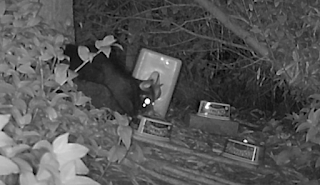
The units are deployed with the back left unit being green, the back right being blue, the front left being yellow and the front right being red.   The units are reading the light level from the LED and do not operate during daylight.     The set up can be shown below at deployment site one.   

The reason for the displacement of the four units from the pattern that is described above was that on the first night of deployment interest in the LEDs was shown and possums moved the (lightweight) units around.   There is no trap associated directly with the units - the key test element here is to see if the blinking LED's will create an interest for the possums to venture to the site and will this be any different from what we have experienced by using a sound lure at this location.

Obviously it is very early in this trial but in the first night we have had ten activations at the site.   This is mid range for what we have been experiencing recently.

However the first night did see the return of a female with a baby to the site (shown in the photo to the left) which showed clear interest in the yellow LED (by pushing its nose against the unit and moving it when it activated).    There was no visit by the large dark brushed tailed possum that has frequented the site over the past several months.   These are both trends and data that we will look to analyse moving forward to see if we can determine the difference that an LED might make.   One thing that we can already state is that the LED's by themselves do not appear to be a source of fear for the possums.  We had several visits to the site and the Timms trap (which has no sound lure attached so is in essence operating as it is intended) was activated by a trapped possum which was caught at 2:05am - of note there were no further visits to the site after this capture.   This contrasts slightly with our last capture on the night of the 1st of January (which was at 1:48am) when there were a further five visits after our last capture the last of which occurred at 4:12am.

Sunday, 7 February 2021

Revised Possum Lure: Experimenting with LED/Stats Update


As we have detailed previously we are preparing shortly to expand the possum part of the process significantly with a fresh look at data gathering at numerous locations in our area.

At each site we are deploying sound lures focussing on possums, and having a second site in the same general location with an indentical set up without the sound lure to compare the results.   Since September 2020 we have been doing this at one location.   Currently we have data that shows at the non sound lure location we have experienced or detailed 199 images of animals and identified 61 instances of specific pest animals, by the large brush tailed possums.   At the sound lure location we have 89 instances of specific pest animals and 458 images of these animals recorded by trail cameras.   

While it is but one location the evidence is suggesting of course that there are more brush tailed possums in the location with the sound lure and the animals at the sound lure location are spending a longer time there including engaging with the sound lure.   There is evidence to show that possums are also engaging with the non sound lure location, including recently rocking or tipping over the bait station (as the mother in the picture with her joey on her back) was seen doing.   Shortly we will be conducting multiple trials with a similar set up but data will be gathered from mulitplication locations including those being conducted by outside organisations to compare to ours.

There are an additional number of aspects to the trial taking place that we will be experimenting with as well. Andrew who is responsible for desiging and creating the electronics for the project has introduced a blinking LED light.   In the example on the left the LED can be seen at the front of the unit just below the line created by the green masking tape.   The LED when the unit plays a sound will repeatedly blink.   During darkness this blink is able to be viewed or noticed from a considerable distance.   While it is currently mounted on a DOC200 the intention is to place the LED in conjunction with a possum unit to encourage possums, who appear to be very curious, to enter the unit or interact with the trap.   

At this stage the LED is red, however further research will be conducted and experimented wtih to see which colour combinations and how ofter the LED is activated to see if it increases interactions with the brush tailed possum


Saturday, 15 August 2020

Sound Lure: Revised Version

 As part of the electronics part of this project targetting Stoats we have been testing and constantly revising the units and making adjustments.   This work is exclusively being carried out by Andrew Hornblow from Opunake who is one of the partners working on the project.   

Recent adjustments for the units include a track being played when the power is connected to the circuit and a blinking LED light as part of the set up.   Both these features allow immediate confirmation that the unit is working and operating.    This video is an example of the unit working:

As we have mentioned previously on this blog these units are now appearing in a variety of locations including New Plymouth Airport, the McKenzie Country South Island, Wataroa - the West Coast of the South Island.    The latest units are being deployed in South Taranaki being used by the Department of Conservation and Project Mounga.   These are specifically targetting Stoats with a sound profile that reflects this.